Naira Volatility: Strategies for Businesses to Stay Afloat by Olufemi Boyede
Part 2
Navigating Naira Volatility: Government Policies, Business Strategies, and Future Outlook
Government Policies
The Nigerian government has recently implemented various policies to stabilise the naira and boost non-oil exports. However, these policies have had mixed results. The Central Bank of Nigeria (CBN) has banned access to foreign exchange to import certain goods like rice, poultry, cement, and fertiliser. This policy is meant to encourage local production and conserve foreign reserves. However, it has also led to shortages and higher food prices as local production struggles to meet demand.
The CBN has also implemented limited exchange rate reforms, moving from a rigidly fixed official rate to a managed float system. However, due to dollar shortages, black market exchange rates continue to diverge significantly from official rates. The CBN has tried to boost supply through direct interventions, which has put pressure on foreign reserves.
To incentivise non-oil exports, the government has introduced several export incentive schemes like the Export Expansion Grant (EEG), which provides tax incentives and rebates to exporters. The Export Credit Guarantee & Insurance Scheme provides credit guarantees and export credit insurance to protect exporters from payment risks. The government has also invested in export processing and special economic zones to support export-oriented manufacturing.
However, exporters complain that funds for many of these incentives are not readily available or are delayed. More must be done to streamline and adequately fund these programs to achieve the desired boost in non-oil exports. Tackling issues like poor infrastructure and multiple tariffs will also help make Nigerian exports more competitive globally.
Business Survival Strategies
As the naira continues its rapid devaluation, businesses in Nigeria face immense challenges to staying afloat and maintaining profitability. However, companies can weather the economic storm with strategic planning and cooperation.
Form Export Clusters and Cooperatives
Exporters should consider banding together in export clusters and cooperatives to optimise costs and increase access to foreign markets. By pooling resources, small businesses can fill shipping containers together and split the cost of transport and other export expenses. This builds economies of scale unavailable to individual small firms. The model has proven successful in countries like India and South Africa.
Practice Prudent Cost Management
Businesses must double down on prudent cost management tactics to mitigate rising overheads from inflation. Steps like resource consolidation, lean staffing, cuts in discretionary spending, and automation of processes can significantly lower operating costs. Businesses should also negotiate with vendors/partners for discounts and favourable credit terms.
Adapt to Changing Consumer Preferences
Companies must keep a pulse on shifts in consumer demand and preferences. Pivoting product offerings or target segments can minimise losses from changes in consumer behaviour. Firms should focus market research on understanding evolving needs and pain points.
Build Customer Confidence
Maintaining open communication and trust with customers is essential in difficult times. If issues like late deliveries arise, proactively informing clients preserves goodwill and confidence. Especially for exporters, nurturing relationships and reliability helps gain market share amidst global uncertainty.


Policy Recommendations
The government must become more intentional with policies to boost production, manufacturing, and trade to stabilise the naira and support businesses during these volatile times. Some key policy recommendations include:
Support for Exports and Production
-
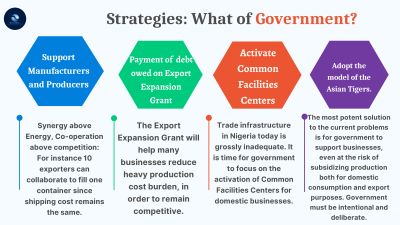
Revamp and adequately fund export incentives like the Export Expansion Grant (EEG) to help exporters reduce costs and stay competitive globally. Over 300 billion naira is owed to exporters in unpaid EEG grants since 2016.
-
Invest in trade infrastructure like roads, rail, ports, and power to reduce costs for exporters and manufacturers.
-
Establish common facility centres to encourage cooperation among producers, especially small businesses.
Manufacturing Support
-
Provide low-interest loans, tax holidays, and other financial incentives for manufacturing companies, especially in vital industries like food production, medicine, and consumer goods.
-
Subsidize critical production inputs like electricity, transportation, and raw materials to lower costs.
-
Prioritize backward integration policies to boost local sourcing of raw materials.
Export Incentives Implementation
-
Clear the massive backlog of unpaid export grants and incentives owed to companies.
-
Simplify and streamline processes for administering export incentives.
-
Expand training and support programs to help more small businesses tap into export opportunities.
-
Set concrete annual export targets and monitor progress.
Deliberate steps by the government to support production and exports will boost foreign exchange earnings, create jobs, reduce reliance on imports, and ultimately stabilise the naira.
Outlook for the Naira
The outlook for the naira remains uncertain as it depends on several domestic and external factors.
Factors that could improve volatility
- Increase in oil revenue if oil prices rise globally
- Increased dollar inflows from exports if non-oil exports grow
- Foreign investments and loans leading to higher Forex reserves
- Government reforms to unify exchange rate regimes
- Tighter monetary policy to curb inflation
Factors that could worsen volatility
- Persistently low oil prices leading to lower oil revenue
- Ongoing high import levels widening trade deficits
- Continued foreign capital outflows and lower FDI
- High costs of government subsidies and debt servicing
- Rising global recession limiting export demand
- Ongoing insecurity issues harming production
Possible reforms
Experts recommend full exchange rate convergence and increased flexibility as reforms to curb naira volatility. This includes adopting a single market-driven exchange rate and phasing out multiple rates. Fiscal reforms like reducing subsidies and improving tax collection are also needed to boost government revenues.
Conclusion
The volatility of the Nigerian Naira has been a major challenge for businesses and consumers in Nigeria. As we have seen, the rapid depreciation of the Naira against major currencies like the US Dollar has made imports more expensive, driven up inflation, reduced the purchasing power of Nigerians, and created an unpredictable business environment.
This presentation has highlighted Naira’s history, recent rapid decline, and its impact on businesses, consumers, and the overall economy. We also discussed some government policies that have been tried and strategies businesses can adopt to stay afloat amidst the volatility.