The Quincy Trio: Mum-Dr Quincy Ayodele (CEO Quincy Herbals), Daughters Marita Abdul, ED Legal Quincy Herbals and Dr Tobi Keeney, MD Quincy Herbals.
Talking Trade Webinar Series: Marketplace Journeys - Quincy Herbals
From Local to Global: Quincy Herbals MD Shares Tips for Expanding Product Reach
Introduction: Embracing the Global Stage
In a world where trade barriers are diminishing, and the internet brings markets closer together, small to mid-sized companies are finding unprecedented opportunities to shine on the global stage. Quincy Herbals, a Nigerian-based herbal products brand, represents a remarkable example of this new era of international business. In this blog post, we’ll explore the extraordinary journey of Quincy Herbals as it transitions from its local roots to a growing global presence.
For decades, industry giants like Coca-Cola, Nike, and IBM dominated the colossus of international trade, whose global reach seemed impossible for smaller players. However, the tide has turned in recent years with the advent of the internet and various countries’ adoption of commerce laws. These developments have opened doors previously closed to African and Nigerian businesses, inviting them to a broader, more inclusive marketplace.
Despite this new landscape, the journey is not without its hurdles. Quincy Herbals, established in 1996, has had to contend with the inherent challenges of international trade policies and issues unique to African businesses, such as underdeveloped processing and packaging techniques and discriminatory company policies. These obstacles, however, did not deter the brand from striving for global recognition, modernizing traditional medicine practices, and advocating for the rightful place of herbal medicine in contemporary healthcare systems.
The Historical Roots of Quincy Herbals
Digging into the annals of African traditional medicine, we find roots as deep and rich as the continent itself. Quincy Herbals, a brand steeped in these traditions, started its journey in 1996. The company was born with the vision of modernizing and promoting traditional African medicine, making products accessible within Nigeria and across the globe. This ambition was to take herbal medicine from the shadow of the ‘alternative’ and place it firmly alongside mainstream healthcare options.
The brand owes much of its traction in the global healthcare market to Dr Quincy, whose significant contributions to the field cannot be overstated. As an expert appointed by the World Health Organization (WHO), she has pioneered the integration of traditional African medicine with modern healthcare. Her work facilitated the recognition of conventional medicine, opening the door for a structured approach to herbal medical practices.
Under Dr. Quincy’s guidance, Quincy Herbals became synonymous with quality and efficacy. Her leadership saw the development of 34 research institutes dedicated to advancing African traditional medicine, mirroring achievements in Ghana, Mali, and South Africa. These institutes serve as centres of innovation and beacons, guiding the global health community to the potential within Africa’s rich herbal heritage.
Overcoming the Obstacles: Challenges for African Businesses
For African businesses dreaming of international success, the playing field is fraught with challenges unique to the continent’s commercial landscape. Quincy Herbals’ narrative is instructive in understanding these challenges and how to navigate them. African/Nigerian businesses have historically grappled with international trade policies that are often viewed as burdensome, packaging and processing techniques that fall below global standards, and company policies that can be discriminatory. These issues create a daunting gauntlet for those seeking to trade beyond their borders.
Quincy Herbals experienced these pain points firsthand, contending with inadequate funding for domestic operations and expansion into international markets. Such financial constraints can stifle innovation and growth, yet Quincy Herbals persevered, adapting and evolving to meet these challenges. They became creative problem solvers, finding new ways to process and package their herbal products that spoke to the quality demanded by international consumers.
Adding to the complexity, African businesses like Quincy must navigate the twin spectres of public perception and regulatory barriers. Quincy Herbals faced scrutiny and scepticism rooted in cultural interpretations of traditional medicine. Burgeoning businesses must, therefore, embark on a dual mission: to battle scepticism with education and push for regulatory reforms that will enable their industries to flourish both at home and worldwide.
Bridging Traditions with Modern Health Practices
Quincy Herbals represents a bold confluence of traditional African medicine and modern health practices, honouring its roots while forging a path ahead. The company has advocated for the proper utilization of herbal medicine, driven by the belief that it deserves a rightful and prominent place in global healthcare. This is evident in Quincy Herbals’ commitment to integrating the traditional with the contemporary, not only in their operational ethos but also in their products, such as their popular organic detox tea and Q Bright Plus skincare line.
This drive to marry time-honoured methods with modern techniques gained brand recognition in various African nations. The endorsement of Quincy Herbals’ approaches by WHO, who has been pivotal in integrating traditional medicine into current healthcare systems, has helped cement this integration, as seen in Ghana, Mali, and South Africa. The company’s advancements mirror a broader trend in which African traditional medicine is being reevaluated and recognized for its potential contributions to healthcare.
Building on the foundation laid by traditional practices, Quincy Herbals has modernized the medicinal practices that have been a part of African heritage for centuries. The brand has become a beacon, showcasing how traditional medicine can meet rigorous scientific standards and be incorporated into modern healthcare regimens. Their success has spurred a renaissance in the appreciation for herbal medicine and prompted a wider acceptance and integration into the healthcare system globally, thanks to trailblazers like Quincy Herbals.
Legal Landscape and Global Significance
Quincy Herbals’ journey through the thicket of global trade has as much to do with legal insight as with product efficacy. In their quest for global reach, they have been guided by keen legal minds like Barrister Marita Abdul, the Legal ED of Quincy Herbals. Abdul’s perspective on the worldwide significance of African traditional medicine imbues it with pride and resilience. She regards Africa’s natural and traditional medicine as a precious commodity, finally receiving the worldwide embrace it deserves.
The company’s foray into the global marketplace has been strategic and deliberate, as evidenced by its successful lines, such as the organic detox tea and the Q Bright Plus skincare products. Both products were developed focusing on natural ingredients, aligning with global trends towards organic and ‘clean’ products. This approach has opened doors for Quincy Herbals and paved the way for other African brands seeking global market penetration.
The global repositioning strategy of Quincy Herbals is bolstered by the conviction that its products can stand shoulder to shoulder with any on the international stage. This belief has drawn the attention of consumers seeking authenticity and effectiveness. It’s a testament to how African traditional and natural medicine, with the proper legal and strategic guidance, can break market boundaries and achieve global success.
Media Strategies and Public Perception
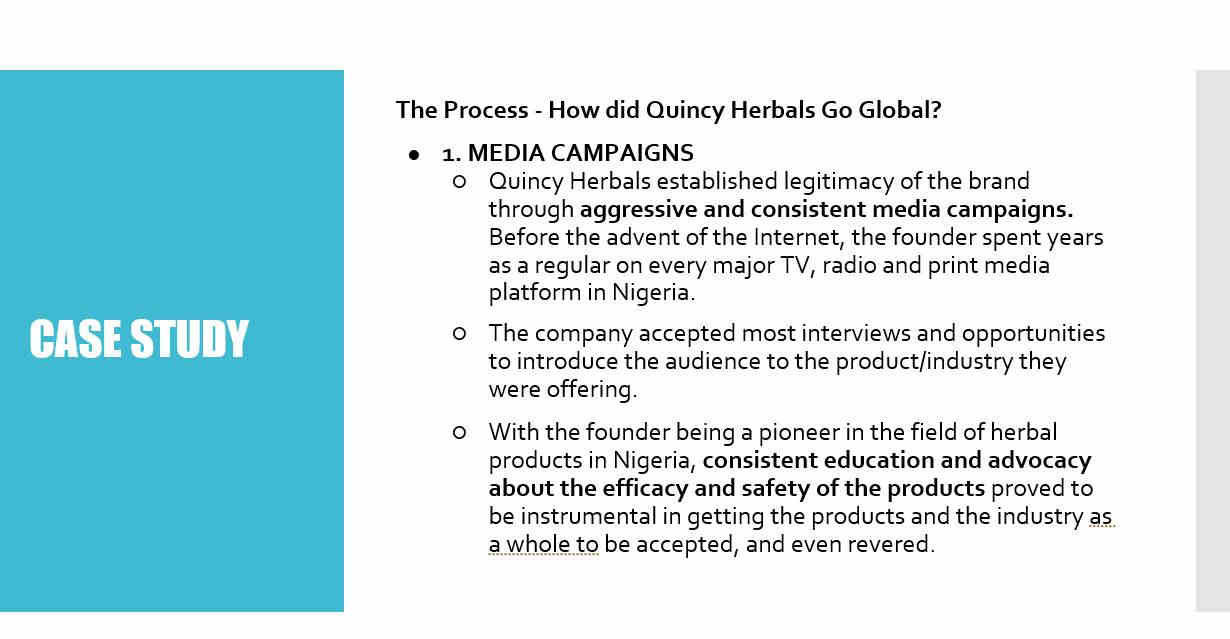
The mission to integrate traditional medicine within the modern health framework is not without its communication challenges. As CEO of Quincy Herbals, Dr Ayodele Quincy faced the daunting task of reshaping the public perception of traditional medicine, often regarded with scepticism due to religious and cultural misconceptions. She undertook this by leveraging persistent and aggressive media campaigns that spanned significant television, radio, and print platforms, thus carving a niche for Quincy Herbals in the national and international consciousness.
Such campaigns were designed to showcase the efficacy and safety of Quincy Herbals’ product line and educate the public about the rich heritage and undeniable benefits of African traditional medicine. Through consistent appearances and interviews, the company was able to address concerns head-on, asserting that the use of conventional medicine is purely medicinal and not rooted in any superstitious or fetish-based practices.
Dr. Quincy’s relentless push for acceptance was a marathon, not a sprint, demanding unwavering persistence. Through educational outreach and advocacy, the stigma surrounding traditional medicine dissipated, allowing Quincy Herbals to build a trusted brand. This journey underlines the importance of a well-thought-out media strategy in altering public narratives and gaining support for traditional practices with historical merit and contemporary relevance.
Growth Strategies: Vertical and Horizontal Expansion
A key element of Quincy Herbals’ robust growth has been its strategic approach to both vertical and horizontal expansion. Vertical growth has seen them focus on scaling products within their existing line of business, as reflected by Dr Tobi Keeney, MD of Quincy Herbals, who spoke about the expansion within the natural medicine industry. Under this strategy, the company has improved its products and services, broadening its reach within the industry by expanding into skincare and natural treatments for chronic diseases. These efforts exemplify the vertical growth that secures a company’s foothold within its initial market while advancing its reach.
Their commitment to evidence-based herbal medicine ensures product quality, focusing on toxicity levels, efficacy, safety risks, and therapeutic indexes. This has set Quincy Herbals apart in the industry, as they have developed products that meet rigorous scientific and health standards, rivalling those seen in conventional medicine. Such a focused and systematic approach to product development and service enhancement is at the heart of a successful vertical growth strategy.
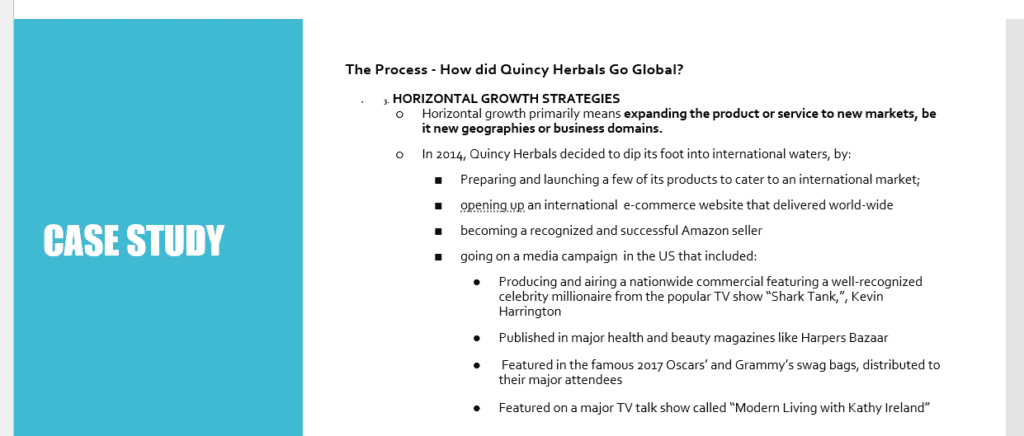
On the other hand, horizontal growth entails expansion into new markets, geographies, or business domains. For Quincy Herbals, this meant reaching beyond the borders of Nigeria into the global marketplace in 2014. The strategic implementation of international e-commerce, partnerships with global shippers like DHL, FedEx, and UPS, and successful selling on platforms like Amazon showcase this horizontal growth. By contracting to manufacture their products, they could adhere to strict branding and quality standards, further strengthening their position.


Stepping Onto the Global Market
Quincy Herbals’ ascent to global recognition involved meticulous strategizing to get their herbal products into the international marketplace. Their approach was multi-faceted: they initiated contract farming and manufacturing medicinal plants and herbs to align with international standards, eagerly awaiting Nigerian policy and laws to catch up. By adopting the latest technology in product processing, they made innovative strides, crafting machines in Nigeria such as dehydrators, encapsulating machines, and grinding machines, all up to global market requirements.
Establishing international standard testing laboratories was a pivotal step in ensuring their products could compete globally. As part of their comprehensive strategy, they also advocated for the passage of the traditional medicine bill, supporting research and development essential for growth. They sought increased government funding for finished products and proposed the creation of agricultural export zones in states with specialized products, thereby connecting primary producers to organized markets.
Engaging in global e-commerce requires the latest technological advancements and intelligent partnerships. Quincy Herbals collaborated with established international shippers to ensure the worldwide delivery of their products, turning logistical challenges into operational successes. This deliberate international expansion, backed by sound policies and technological prowess, has underscored Quincy Herbals’ readiness to meet the demands of a shifting global marketplace where agriculture and herbal products are increasingly assuming centre stage.
Policy Advocacy and Technology Integration
The road to global success is paved with advocacy and innovation, and Quincy Herbals knows this all too well. They championed the cause of traditional medicine through policy advocacy, pushing for advancements and a supportive environment for their industry to prosper. Their efforts included setting up agricultural export zones and proposals for government funding under the commercial agricultural development program. These steps aimed to gain the recognition that herbal products deserve and ensure that these initiatives aligned with shifting global market trends, especially as the world increasingly looks beyond fossil fuels toward agriculture and herbal products.
Quincy Herbals’ bid for international acclaim was accompanied by their integration of the latest technologies in product processing, developing machines locally that could meet the high standards of global production. This technological leap was about meeting export requirements and carving out a niche in the competitive herbal products market.
Their strategies exemplify how a company can lead the charge in a field that holds historical and cultural significance while adapting to contemporary market demands. The journey of Quincy Herbals illustrates the importance of harmonizing policy advocacy with technological advancements. It shows that with vision and effort, even the most indigenous of businesses can take their rightful place on the global stage and, in doing so, pave the way for a healthier, more sustainable future.
Conclusion: The Future of Herbal Medicine Globally
Quincy Herbals’ narrative is more than just the story of a company; it is the chronicle of an industry’s ascent to global prominence. The brand’s hard-won successes offer invaluable insights for others seeking to take their products beyond local markets. The roadmap laid out by Quincy Herbals — marked by strategic growth, legal and policy advocacy, and technological advancement — serves as a blueprint for elevating traditional medicine to its rightful global stature.
Through their trials and triumphs, Quincy Herbals has shown that African traditional medicine can gain international acclaim by embracing modern practices, engaging in continuous education, and adhering to the highest standards. Their success is a testament to the potential for herbal medicine to coexist with and enhance modern healthcare. As they expand and adapt, Quincy Herbals sets the stage for the global herbal medicine industry’s bright future.
This is not the end but a new chapter for Quincy Herbals and the global perception of herbal medicine. The future promises greater acceptance and integration, with the potential for remarkable collaborations between traditional and modern medical practices. Companies like Quincy Herbals, rooted in tradition yet innovating for tomorrow, chart the course for a world where holistic health is not just a niche but an integral part of the global healthcare system.